

Cyber risk is becoming a business reality
When business owners think about cyber crime, they may picture hackers targeting large organisations with sophisticated technology. In reality, cyber incidents often start with something far more ordinary: an employee clicks a convincing email link, a supplier payment is redirected to a fraudster, or login credentials are compromised.
The challenge today is not simply recognising that cyber risk exists. Organisations are already aware of the threat. The real questions are whether your business is prepared for what happens next and could it continue to operate if your IT systems became unavailable tomorrow.
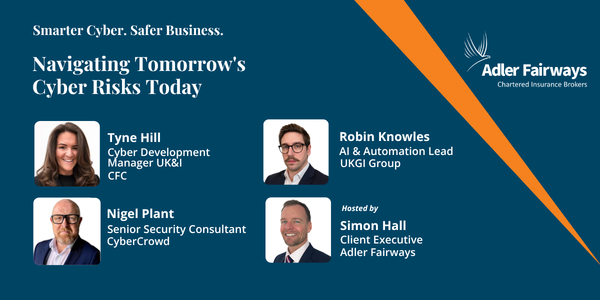
This was one of the key themes discussed by Tyne Hill, Cyber Development Manager UK & Ireland at CFC, during Adler Fairways’ Navigating Tomorrow’s Risks Today webinar. Tyne Hill focused on the reality of responding to a cyber incident and the support that can be available when an attack occurs.
Recent research from CFC, published in its Cyber Insurance Disconnect report, found that cyber attacks and data breaches are now cited as the number one business risk among SMEs surveyed, while nearly three in five UK SMEs reported experiencing a cyber event within the last three years.
Recent developments show how quickly cyber risks can emerge. Following the discovery of critical vulnerabilities in PHP, a technology widely used to power websites and online services, the National Cyber Security Centre (NCSC) encouraged organisations to install security updates immediately. The NCSC also advised organisations unable to apply the updates, to consider taking affected systems offline until they could be secured.
Everyday mistakes can have serious consequences
Yet despite growing awareness, organisations remain vulnerable. One of the report’s key findings was the role human error continues to play in cyber incidents, contributing to 75% of cyber claims in 2025. Whether through a phishing email, a fraudulent payment request or an employee unknowingly providing access to systems or data, seemingly routine actions can have significant consequences. While ransomware often attracts headlines, some of the most damaging incidents can stem from day-to-day business activities.
AI is changing cyber crime
Artificial intelligence is adding yet another layer of complexity. As organisations use AI to improve productivity and efficiency, cyber criminals are also using it to their advantage. AI can help create more convincing phishing emails and realistic impersonation attempts, making attacks faster, harder to detect and easier to scale. As a result, it can become increasingly difficult for your employees to distinguish genuine communications from malicious ones. In fact, 72% of UK SMEs surveyed expect AI to increase their organisation’s cyber risk over the next two to three years.
Make sure you have the support when an incident occurs
The webinar also highlighted an often-overlooked aspect of cyber resilience: what support is available when an incident occurs. The research suggests there remains a gap in understanding around cyber insurance. Many respondents were unaware that some cyber insurance policies may provide access to specialist incident response teams, legal support and guidance alongside financial protection.
Cyber resilience is not just about preventing attacks. It is about understanding your exposures, preparing for potential disruption and ensuring you have the right support in place if the unexpected happens.
Talk to us about your cyber risks
If you’d like to discuss the cyber risks facing your business or understand how cyber insurance could support your wider resilience strategy, we can help you explore the options available and identify cover that reflects your business’s needs, giving you greater confidence that the right support is in place should a cyber incident occur.
Sources: CFC – The Cyber Insurance Disconnect

Oliver Steppe
Client Adviser
Adler Fairways